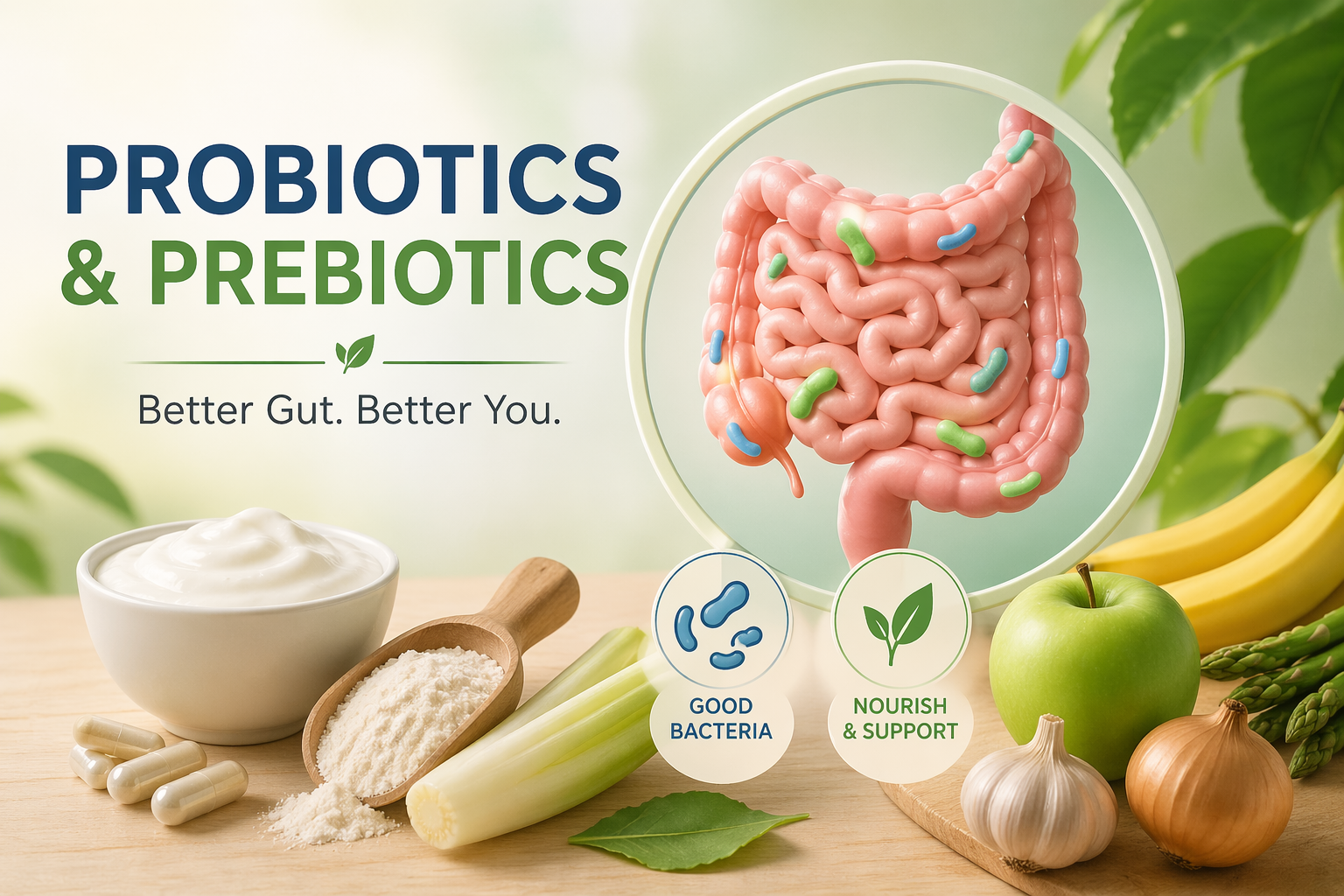
This article explains how probiotics and prebiotics support gut health in different but complementary ways. Probiotics are beneficial live microorganisms that can help improve digestion, support the immune system, and may assist with issues like diarrhea and IBS, while prebiotics are fibers that feed and strengthen these good bacteria. It highlights that their effects are not universal and depend on specific strains, types, and individual responses. The article also emphasizes the growing scientific evidence behind their role in digestion, metabolism, and even mood, while encouraging careful, evidence-based use rather than assuming all products work the same.
Gut health has moved from a niche topic to a mainstream wellness conversation, and probiotics and prebiotics are now two of the most discussed tools in that space. They are not the same thing. Probiotics are “live microorganisms that are intended to have health benefits,” while prebiotics are “a substrate that is selectively utilized by host microorganisms conferring a health benefit.” Those two definitions matter, because they explain why one helps by adding beneficial microbes, while the other helps by feeding the microbes already living in your gut.
The modern interest in these ingredients comes from a simple idea: the gut microbiome is not passive. It helps shape digestion, barrier function, immune signaling, and possibly even parts of mood and metabolism. That does not mean every probiotic or prebiotic product is a miracle solution. It does mean the science is real enough to justify careful, evidence-based attention.
What probiotics do in the body
Probiotics are live microbes, usually bacteria and sometimes yeasts, that are taken in foods or supplements. Common groups include Lactobacillus, Bifidobacterium, and Saccharomyces boulardii. Their effects are not universal. In fact, the NIH Office of Dietary Supplements notes that probiotic benefits can be strain-specific, and the same species or even the same genus may not produce the same outcome.
That strain specificity is one of the biggest reasons probiotics are both promising and confusing. People often speak about “probiotics” as if they were one thing, but the evidence base works more like a library of individual microbes and combinations, each with different strengths. The World Gastroenterology Organisation also emphasizes that recommendations should be tied to specific strains and human studies, not just broad product labels.
Evidence-based benefits of probiotics
1) They may help with certain types of diarrhea
This is one of the clearest areas where probiotics have shown useful effects. NCCIH says there is some evidence that probiotics may be helpful for acute diarrhea and antibiotic-associated diarrhea, and the WGO guideline reports moderate effects in meta-analyses for preventing antibiotic-associated diarrhea in children, adults, and older adults.
A 2017 review summarized by NCCIH found that giving probiotics alongside antibiotics was associated with about half the likelihood of antibiotic-associated diarrhea, although the quality of the evidence was only moderate. For readers, the key point is not that every probiotic works, but that certain strains appear helpful in specific situations, especially during antibiotic use.
2) They may improve some IBS symptoms
Irritable bowel syndrome is one of the most common reasons people try probiotics. The science here is mixed, but it is not empty. NCCIH notes that a 2020 review of 35 studies and 3,452 people found that probiotics may relieve abdominal pain, bloating, and gas, especially in combination products. At the same time, the evidence is still not strong enough for a universal recommendation, and the American College of Gastroenterology guideline is cautious.
That caution matters. Different strains, different doses, and different study designs can produce very different results. Some reviews show improvement in stool consistency or symptom scores, while others find no meaningful benefit. So probiotics may be worth discussing for IBS, but they should be treated as a targeted trial, not as a guaranteed fix.
3) They may support the gut barrier and immune signaling
One of the more interesting mechanisms behind probiotics is gut barrier support. The NIH Office of Dietary Supplements explains that probiotics may help by producing bioactive metabolites, lowering colonic pH, inhibiting pathogens, and even reinforcing the gut barrier. Some strain-specific effects also involve immune and nervous system signaling.
This is one reason probiotics are often discussed in the context of overall resilience. The evidence for broad “immune boosting” claims is not equally strong for every product, but the gut-immune connection is biologically plausible and actively studied. WGO notes suggestive evidence for some probiotic strains and for certain prebiotics in improving immune response.
4) They may help some people with skin-related concerns
NCCIH notes that there is some evidence probiotics may help with atopic eczema, especially in infants, although the effect is limited and not universal. This is a good example of how probiotics are best understood as condition-specific tools rather than general-purpose wellness pills.
5) They are being studied for wider metabolic and mental health roles
Researchers continue to study possible links between probiotics and obesity, type 2 diabetes, and even mood-related outcomes. The evidence is still emerging, so these areas should be described carefully. The National Center for Complementary and Integrative Health notes that probiotics and microbiome science are being explored for body weight, susceptibility to cancer, and behavior, but also stresses that clinical trial results can be inconsistent.
What prebiotics do in the body
Prebiotics work differently. Instead of adding microbes, they feed beneficial microbes that are already present. NCCIH describes them as specialized plant fibers and nondigestible food ingredients that nourish good bacteria in the colon. The WGO guideline explains that prebiotics are nondigestible by the host and can confer health benefits through a positive influence on resident beneficial microbes.
Common prebiotics include inulin, fructooligosaccharides, galactooligosaccharides, and lactulose. Because they are fermented by gut microbes, they can help produce short-chain fatty acids and may support a more favorable gut environment. That is a major reason prebiotics are often linked to digestive health and microbial balance.
Evidence-based benefits of prebiotics
1) They help beneficial bacteria grow
This is the core prebiotic benefit. By selectively nourishing helpful microbes, prebiotics can encourage a gut environment that is more supportive of balance and diversity. In practical terms, that means the microbiome gets better fuel for the organisms you want to thrive.
2) They may support digestion and regularity
Prebiotics are often discussed in relation to bowel function because they can influence fermentation, stool bulk, and microbial activity in the colon. However, the response depends heavily on type and dose. NCCIH notes that while prebiotics are generally considered safe, high amounts can cause gas, bloating, abdominal pain, cramps, and diarrhea.
That means prebiotics are not automatically “gentler” than probiotics. In some people, especially those with IBS, certain prebiotic fibers can actually worsen gas and discomfort. In one review summarized by NCCIH, non-inulin-type fructans in moderate amounts improved flatulence, while inulin-type fructans increased it.
3) They may support metabolic health in emerging research
Prebiotics are also being studied for metabolic benefits, including possible effects on body composition, glucose control, and lipid profiles. The evidence is promising but still developing, so this should be framed as an active research area rather than a settled claim.
Probiotics vs prebiotics vs synbiotics
Think of probiotics as the “workers” and prebiotics as the “food supply.” When both are used together, the combination is often called a synbiotic. The NIH Office of Dietary Supplements says products containing both are often called synbiotics, and NCCIH has also described probiotic-prebiotic combinations as a way to influence gut microorganisms together.
This is one reason combination formulas are popular. In theory, the prebiotic helps the probiotic survive and function. In practice, the real-world benefit depends on the exact strains, the exact fibers, the dose, and the person taking them.
How to choose them wisely
The first rule is to be specific. Not every product labeled “probiotic” has proven benefits, and not every fermented food contains clinically validated probiotic strains. The second rule is to look for strain names, not just genus names. The third rule is to match the product to the reason you are using it, because the strongest evidence is usually condition-specific.
For probiotics, product quality matters too. The NIH Office of Dietary Supplements notes that higher CFU counts are not automatically better, and labels should ideally state the number of viable organisms at the end of shelf life. For prebiotics, start slowly, because too much too fast can create the exact bloating and gas you may be trying to avoid.
Who should be careful
Probiotics are usually well tolerated in healthy people, but there are important exceptions. NCCIH warns that serious complications, including infections, have occasionally been reported in people with underlying health problems, and premature infants are a special concern. The FDA has also warned health care providers about severe or potentially fatal infections in premature infants given probiotics.
Prebiotics are generally considered safe, but large doses can cause digestive side effects. That is why both categories are best introduced thoughtfully, especially if you already have a sensitive digestive system or a diagnosed GI condition.
Final Overview
The real value of probiotics and prebiotics is not hype, but precision. Probiotics may help by adding beneficial microorganisms, and prebiotics may help by feeding the microbes already doing useful work in the gut. Together, they can support digestive balance, and in some cases they may help with diarrhea, selected IBS symptoms, barrier function, and other health areas under study. But the science is not one-size-fits-all. The best results come from matching the right ingredient, the right strain or fiber, and the right dose to the right goal.
FAQ
Are probiotics and prebiotics the same thing?
No. Probiotics are live microorganisms, while prebiotics are nondigestible ingredients that feed beneficial gut bacteria.
Can they help with bloating?
Sometimes. Certain probiotics may help some people with IBS-related bloating, but some prebiotics can also increase gas and bloating, especially at higher doses or in sensitive people.
Is more CFU always better for probiotics?
No. The NIH Office of Dietary Supplements notes that higher CFU counts are not necessarily more effective than lower ones.
Should everyone take them?
No. They may be useful for specific goals, but people with weakened immune systems, serious illness, or premature infants should be especially cautious with probiotics, and anyone with digestive sensitivity should introduce prebiotics carefully.
Scientific sources and further reading
You can open each source by clicking its citation:
- NIH NCCIH – Probiotics: Usefulness and Safety.
- NIH NCCIH – 5 Things To Know About Probiotics.
- NIH Office of Dietary Supplements – Probiotics fact sheet for health professionals.
- NIH NCCIH – Irritable Bowel Syndrome: What You Need To Know.
- NIH NCCIH Clinical Digest – IBS and Complementary Health Approaches.
- World Gastroenterology Organisation – Probiotics and Prebiotics guideline.
- ISAPP prebiotic definition in PubMed.
- ISAPP probiotic definition in NIH ODS.
- NCCIH research note on probiotic-prebiotic combination and stress.